Storm Concept Review
Urethane-level predictability with reactive hitting power. Storm's SPI Lab Series control piece at $189.95. Video inside.
Hey everyone, Kyle Troop here and welcome back to the channel. Today, as you can see, I have the Storm Concept [music] here in front of me and I would like to give you somewhat of a lengthy review about this ball. This ball is a game changer. I'm just going to say that right off the bat. It's a game changer. Little bit of spec talk about it. RG261 and differential 018. I do understand those two numbers may scare some people
away. Uh you don't see those numbers in pretty much any resin ball nowadays. Uh this is purely resin. There is no urethane in this. So it is allowed to be used in all [music] competitions. The reason why it has 261018 for the numbers is because of this cover. This cover that Storm Products created they say is the strongest cover stock they have ever created. uh they've never been able to use this cover stock on what I would like to say a normal
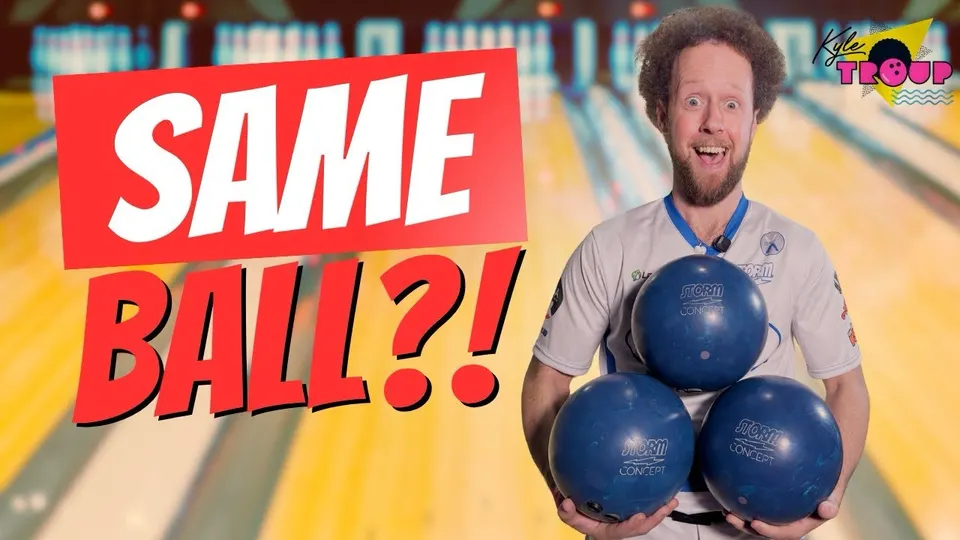
core or 25 040 because it's just going to flare out. It's just going to hook too much. It's [music] going to puke on itself. So, this is a very unique piece. She's unique. >> You're wondering probably what do I got going on with the three balls here. We have the same pin distance and the same mass bias distance. The only difference will be the distance the pen is from the center of my grip. First one here, four by 4 and a half. So
4 in pin, 4 and 1/2 in mass, 2 in from the center of my grip. Second one here, 4 in pin, 4 and 1/2 in mass, 4 in from the center of my grip. And lastly, 4-in pin, 4 and 1/2 in mass, 6 in from the center of grip. So, that's a little bit about the tech talk of this ball. I'm going to throw [music] all three. I am bowling on a 39 ft Don Johnson pattern. So, nice little medium
pattern to show you how they compare to one another. Show off maybe the lower pin, which I would expect to be a little straighter. This has been [music] my favorite so far. And the 6 in really allows me to open up the lane. So, let's hit the lanes and see how they go. All right, everyone. Here we go with the Storm Concept review. Like I said, I am going on 39 foot Don Johnson. Uh, I did hit all three of these concept with a 1000 grit Aberlon pad, so they have the same surface. And we're going to start pretty much with the lowest pen to center grip and go up from there. So,
the first one 4x 4 1/2x two. I would imagine this is going to be one of these smoother, straighter ones. Uh my goal with having the lower pin would [music] be for me be to be able to stay a little closer to the friction on some of these shots. >> All right. All right. There was a little left and first shot with the surface.
That was a little more about what I was expecting. Uh, got that one out a little bit. 39 ft. It is on the fresh. So, my break point is a little further right, but [music] we're going to throw this a few more times. Feel it out from around the same part of the lane. Nice and smooth off of the back. That was about one or two left with my feet. I'm going to move again. I'm [music] going to probably continue to move a
couple boards just so we can get into some oil to kind of really see the difference in [music] the mid lane and the backend reaction with these three different layouts. Moving a couple left. Probably going to bring my break point in a couple as well. >> I like that shot. I like it. I like it. That's probably about a good four left
off of where I did throw the first couple shots with it. I'm going to give it a little bit better pass, [music] but with it being 2 in from the center of my grip, it's not flaring very much at all. Uh so I shouldn't be able to open up the lane too too much with the lower pin to center grip. We're going to throw one more. We're going to move back to the right, even a little further than where we started,
just to see if this thing just really allows me to pump it or [music] keep it in front of me more with this lower pin one. Wow. All right, one more. I want to move a couple more. Right. See kind of where the limit is with this one. >> Off limits >> cuz I would say that speed was probably
a good mile an hour faster than the first few shots. So, we're going to move a couple more. All right. So, I would say the sweet spot probably anywhere from like 8 to 12 with my feet. You know, that was a little too far. And you can see it, you know, once they get offline, which on 39 ft, you're typically not going to play that straight with equipment most of the
time. So, we are now going to switch to the 4inch pin to center grip. And we'll probably start where we finished off with the 2-in [music] one and move left and see how much more overall motion we can get out of that. Now 4in pin 4 and 1/2 in mass bias to access point and 4 in pin to center grip from the same spot as the 2-in pin
to center grip. This is my favorite one out of all three. >> Kind of wonder, well, Kyle, you just struck from the same spot, same part of the lane as the 2-in pin. Yeah, but this one definitely kind of picked up in the mid lane a little sooner and almost bled off a little more because with the lower
pin, yes, it allows me to stay closer to the friction, but it also wanted to kind of get off line a little bit too early as well. So, [music] I'm going to keep messing around with this 4in one. I'm going to move a couple. Okay. Okay. Uh, was sliding 21 instead of sliding 18. So, that's about three left. I did get that kind of far to the right.
Let's keep feeling it out. Let's keep feeling it out. >> Just feel. >> So, as we're moving left on 39 ft, you can't just always continue to throw it right of five down the lane because sooner or later you're going to kind of get on the wrong side of the pattern playing in this zone. So, we're going to try and bring the break point in some. That was not a very good shot at all.
So, no matter which one I throw, we can't be spinning it like that. No, we cannot. That's what we're looking for. Actually kept my brake point in a little bit. That is almost a little more comfortable for me because I I don't feel like I'm fighting the fronts as much. I don't have to have [music] my ball speed up a little bit more. You know, that's around
my comfort ball speed zone. We don't have speed up there, so I can't [music] tell you the exact speed. All right. So, we're going to move another one or so off of that last one. You know, get this speed down into a comfort zone that we're a little more comfortable with.
All right. Mind you, 261 018. That's a lot of hook. That's a lot of hook right there. But now we have moved probably a good six boards left now off of the 2-in pin one. We're going to stay there. Just throw one or two more with this one and see if we go to the six. And it almost allows me to free it up a little bit from being this far left.
And it's still hooking. It's still hooking. We got the speed a little bit lower now, but you can definitely see overall just more motion compared to the lower pin because typically the lower the pin, the less the flare. So, another way you could say that, the lower the pin, the less overall hook that you're going to get out of the ball. [music] All right, one good pass here. That's money.
>> Money. >> Slid about 24. So, I might have drifted a little bit more there, but all right. We're going to now go to the 6-in pin to center grip. See the difference this one makes. All right. So, like we said, 4x 4 1/2x 6. Then way up there. Way way up there. >> Way way up there. [music] >> Let's see what happens.
That was about the same spot as the four. I might have got around it a tad, but I think we uh we found some hook with this layout. Definitely going to make a move off of our after our first shot with this one. We'll go and move another two. We seen lots of hook out of it the first time. But now, keep in mind as I continue to move left, the break point has to come left with me.
Sliding 27. Good nine to 10 boards left off of the first one. And you know, this does feel like I might be getting a little too far left with these, but you know, we're trying to show off a little bit. Trying to show off the different motions. I still like that because if you were [music] to tell me 261018, I feel like I'd probably be trying to play up five on, you know, no matter what the layout is. But I mean, I
probably wouldn't even be hooking it this much with some of our normal resin balls, so to speak. Jeez. Wow. This one hooks. Holy cow. I guess we keep moving. Keep moving. I don't know. Haven't really thrown this one too much. So, kind of learning [music] with you guys. >> We can learn it together.
>> I don't really know what the limit is on this ball yet. Sliding 30. All right, that might be the limit. You know, quick tip there. Headpin coming in front of the 10. You know, people just think, "Ah, the messenger missed." Typically, when it goes in front of the tenpin, the ball's coming in too late. It's coming in behind it a little bit. So, to me, [music]
I don't think I needed to move any more left because that was pretty good. And she kind of came in behind it. So, let's just dial in. No more experimenting. Time to just throw a couple strikes. I will say oil feels like it's getting down the
lane a little bit. You know, that's the other thing to learn with this concept is how it transitions the lane. You know, people think, [music] you know, oh, it's urethane. Well, you know, it's not urethane whatsoever. It's all resin. Bang, bang. I sliding 27. I was sliding like 18 with the first one. And it went through the eight pin. It's not like we're really working super
hard, but [music] so 6 in 6 in from the pin to the center of the grip. And as you can see, there's still not a whole lot of flare on this ball. This is 6 in. Remember, higher the pen, the more flare. So, that's still a lot of hook for that little amount of flare. And I think that's just because of the strength of the cover. [music] You know, they said it's the strongest cover they've ever used. We had a cover stock that was unusable, like unusable because it hooked so much.
>> But with the 261 and 018, you're not going to feel that strong cover right in the front of part of the lane. you know, the core allows the cover to get down the lane, which then gives you still a smoother reaction off of the back. Cuz even at this even at this 6-in pin, I still feel like it's nothing that's drastic off of the back end of the pattern. To finish the video, we're going to see how good I am. I'm going to just go 2 in, 4 in, 6 in. One
shot each. See what we got. That's all right. 2 in. Very clean. Not a lot of hook whatsoever. 39 ft. Probably wouldn't be using that one on 39 ft. But we get on some of these even shorter patterns. 37 Viper, short cheetah, wolf, you know, some of those other ones. I think that one's
going to really come in handy if I want to stay on top of it. Keep it in front of me. Now to the 4 inch. 4 inch. Let's see. All right. There we go. That was five left with my feet at the foul line. That's my favorite one. I said it at the beginning of the video. four by four and a half by four.
I feel like I don't have to play too far left with it. I also don't need to get caught playing too far right with it. Just a little happy zone in the middle. Maybe there's a happy tree. All right. And to finish it off with the big boy 6 in.
Well, so the 2 in got a weak tin, the 6 in 4 pin, and the 4 in. Perfect. So, two things from the video I want you all to take away from this. One, concept is a game changer. And two, I hope you can see how you can change the reaction of the bowling ball by just messing with the third number in 2 LS. you know, having the same pin distance, the same mass bias to pap distance, you know,
just moving that pin up and down 2 in 6 in really changes the motion of the bowling ball. So, thank y'all for tuning in. Shout out to Jtown Striking Spare here for letting me do this video, show off the concept, where to get a concept inside.com. I'll see you on the site. Peace. [music]
Performance Analysis
Performance Analysis
Testing revealed the Storm Concept delivers surprising hook potential despite conservative RG specifications (2.61 RG, 0.08 differential) that typically indicate lower-hook characteristics. On a medium house oil pattern, independent reviewers observed that the reactive pearl coverstock absorbs oil unusually fast—showing minimal oil tracking after the first shot compared to urethane alternatives—yet maintains strong angular motion downlane. The ball demonstrated a smooth, controllable reaction when thrown from the right side of the lane (around boards 17–23), with consistent hook through the pin and strong carry. Reviewers noted the coverstock appeared to shed factory grit relatively quickly, transitioning from a dull finish to a smoother surface as play continued, which may affect early-session behavior.
On medium-to-heavy oil conditions, the Concept showed more measured motion rather than an aggressive backend snap, positioning it as a complementary option to heavier benchmark pieces rather than a replacement. When moved into heavily oiled or fresh patterns, the ball’s aggressive middle-lane oil absorption became a limitation—it struggled to create significant backend response when carrydown hadn’t yet developed. Testing suggested the ball performs best when oil is still present in the midlane, making it ideal for tour conditions where patterns remain more uniform. Comparatively, independent reviewers found it offered cleaner midlane read and more backend energy than some urethane-style alternatives, making it a legitimate option for bowlers seeking a reactive pearl with smoother motion characteristics and predictable ball reaction.
Who Is This Ball For?
The Storm Concept is best suited for rev-dominant bowlers and tour players seeking a secondary reactive option that doesn’t duplicate coverage already in their bag. Its smooth, controlled motion and efficient oil absorption work well for bowlers who prefer finesse over aggression—particularly those playing fresh or lightly-oiled house shots where the ball’s gentle shape won’t overreact. The moderate core dynamics make it accessible to bowlers with moderate-to-higher revolutions who want predictability without sacrificing performance.
This ball will appeal less to low-rev bowlers or those bowling on heavily oiled sport patterns, where the Concept’s inability to create dramatic backend reaction becomes apparent. Similarly, bowlers seeking a workhorse heavy hitter may find it too controlled. However, for competitive bowlers building a well-rounded arsenal or tournament players needing a “tweener” option between their benchmark pieces, the $189.95 price point makes it a sensible addition that delivers genuine performance benefits on the patterns where it excels.
The Pros
- • ARC Pearl coverstock runs at USBC maximum friction and oil absorption
- • Urethane-level control with reactive hitting power
- • Exceptional on short patterns and sport conditions
- • SPI Lab Series pedigree — cutting-edge R&D
The Cons
- • Conservative core limits total hook potential
- • Not ideal for heavy oil volume
- • Higher price point for a control piece
Who Is This Ball For?
Urethane-level predictability with reactive hitting power. Storm's SPI Lab Series control piece at $189.95. Video inside.
Technical Specifications
How It Compares


More Videos (16)

Storm Concept Ball Review!!
Malia Briggs
It's NOT Urethane | Storm Concept
The Hype
Storm Concept Bowling Ball | 7 Ways
Storm Bowling Products Inc.
STORM CONCEPT | Living Up To The Hype??
Luke Rosdahl
The Ultimate Short Pattern Test: Storm Concept vs IQ 78U vs Level
Real Experience Bowling
Power Player vs Tweener: Storm Concept
Real Experience Bowling
PBA Pro vs League Bowler! | Storm Concept Review
Beef and Barnzy
Storm - Concept: Urethane-Style Motion?
The Bowling Passport
THIS CONCEPT IS REALLY INTERESTING | Storm Concept | Deep Dive Ball Review
Creating the Difference
What do you think about the Concept so far?
The Bowling Passport
Storm Concept - NEW NOT URETHANE! - 3 Testers
TamerBowling
STORM CONCEPT | Does Storm Finally Have A Contender??
Luke Rosdahl
Brand NEW Storm Concept! Smooth! 🔥🔥 #bowling #bowlingballs #stormbowling #bowlervibes #reels #fyp
Real Experience Bowling
The Newest Concept in Bowling | Introducing the Storm Concept
Storm Bowling Products Inc.
Perfect Strike With The Storm Concept
Brad and Kyle
Throwing Strikes with the Storm Concept!
Brad and KyleFrequently Asked Questions
What oil condition is the Storm Concept best for?
Is the Storm Concept good for beginners?
What is the RG and differential of the Storm Concept?
How much does the Storm Concept cost?
What type of bowler should use the Storm Concept?
Explore More Reviews
Other Medium Oil Balls


More from Storm


Similar Price Range


Never Miss a Release
Join serious bowlers getting the weekly data dump on new ball releases and performance data.